
Pros and Cons of Studying MBBS Abroad: A 2026 Guide for Indian Students
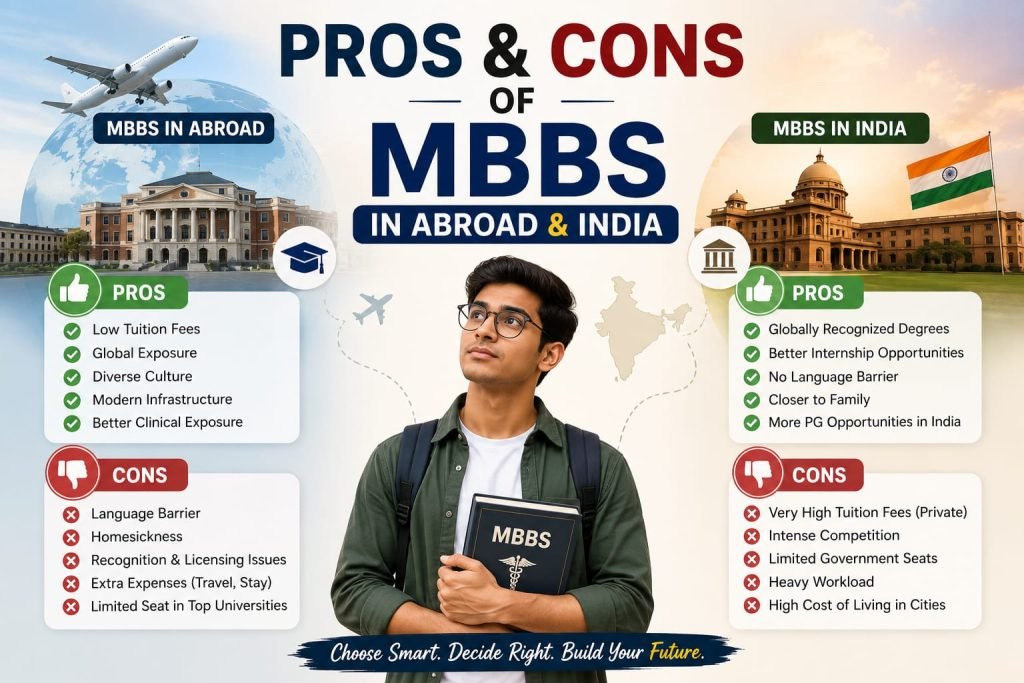
Studying MBBS abroad can be a smart choice for Indian students who want an affordable, globally recognised medical degree without a top NEET rank. The main pros are lower fees (about ₹20–45 lakh total), easier admission, and modern campuses. The main cons are the tough FMGE/NExT licensing exam, language and culture gaps, and the risk of picking a college that India does not recognise.
So the honest answer is: studying MBBS abroad is worth it only if you choose the right country and an NMC-approved, WHO-listed university — and prepare early for the exam you must clear to practise back home. This guide lays out the real advantages and disadvantages of studying MBBS abroad in 2026, the FMGE/NExT reality, how it compares with MBBS in India, and how to decide if it fits your profile.
Key takeaways
- Cost: MBBS abroad costs roughly ₹20–45 lakh total vs ₹60 lakh–₹1.2 crore at most Indian private colleges. verify
- Admission: You need a valid NEET qualifying score — not a top rank — plus the university must be NMC-approved and WHO-listed.
- The catch: To practise in India you must clear the FMGE/NExT screening exam. The FMGE June 2025 pass rate was just 18.61%.
- Top risks: non-recognised colleges, agent traps, language barriers in clinics, and hidden living costs.
- Best for: students with a moderate NEET score and a tight budget who are ready to study hard for the licensing exam.
Pros and cons of studying MBBS abroad at a glance
Here is the quick comparison most students come for. Each point is explained in detail further down.
Advantages and disadvantages of studying MBBS abroad (2026)
| Parameter | Details |
|---|---|
| MBBS Course Duration | 6 Years (including 1 year internship) |
| Mode of Teaching | English |
| MBBS Fees in Russia | ₹ 20–35 Lakhs (total) |
| Cost of Living | ₹ 10,000–15,000 per month |
| Hostel Fees | ₹ 5,000–12,000 per month |
| Currency | Russian Ruble (RUB) |
| Currency Exchange Rate | 1 Indian Rupee = 0.79 Russian Ruble (April-26) |
Advantages of studying MBBS abroad
The biggest advantages of studying MBBS abroad are cost, easier access, and a globally recognised degree. Here is what each one really means for an Indian student.
PROMuch lower fees
A full MBBS abroad usually costs ₹20–45 lakh for the whole course, depending on the country and university. Indian private colleges often charge ₹60 lakh to ₹1.2 crore for the same degree. For many families this is the single biggest reason to look abroad.
PROEasier admission
You do not need a top NEET rank. Most approved foreign universities only ask for a NEET qualifying score and your Class 12 marks in Physics, Chemistry and Biology. There is no separate entrance war for a handful of seats.
PROGlobally recognised degree
Approved universities in countries like Russia, Georgia and Kazakhstan are listed in the WHO World Directory of Medical Schools and recognised by India’s NMC. A recognised degree lets you sit licensing exams in India, and later the USMLE (USA) or PLAB (UK) if you want to work abroad.
PROEnglish-medium teaching
Most MBBS abroad programs for international students are taught fully in English. India’s NMC rules also require the course to be in English. So classroom learning is not the problem — the local language only matters later, in the hospital.
PROModern campuses, early clinical exposure
Many universities offer modern labs, simulation centres and hands-on hospital time from early years. Students often see a wider range of cases than they would in an overcrowded setting back home.
PROInternational exposure
You study with classmates from many countries, learn to handle different patient profiles, and build a global outlook. This experience can help if you later plan to work or do a residency outside India.
Disadvantages of studying MBBS abroad
The disadvantages of studying MBBS abroad are real, and ignoring them is how students get hurt. Here are the cons you must plan for before you decide.
CONThe FMGE/NExT licensing exam
To practise in India after an MBBS abroad, you must clear the FMGE (soon the NExT). Pass rates are low — only 18.61% passed FMGE in June 2025. The degree alone does not let you work in India; the exam does. verify
CONRisk of non-recognised colleges
Some foreign universities are not approved by the NMC. A degree from them cannot be used to sit the FMGE/NExT or practise in India. Choosing the wrong college can cost you the whole career — this is the most dangerous mistake.
CONAgent traps and false promises
Some agents push students into unapproved colleges for a commission, or hide later-year fee hikes. Always check approvals yourself and work with an honest, transparent counsellor.
CONLanguage barrier in hospitals
Lectures may be in English, but the patient in a Russian or Georgian ward may not speak it. Clinical training often needs the local language, so you have to learn it well enough to take a patient history.
CONClimate, food and culture shock
Harsh winters, unfamiliar food, limited vegetarian or Indian options, and being far from family can be hard — especially in the first year. It is manageable, but you should be ready for it.
CONHidden costs and uneven quality
Low tuition can hide costs like food, hostel, visa renewals and travel. And teaching quality and clinical exposure vary a lot between universities, so research matters.

The FMGE / NExT reality you must plan for
Every Indian student who does MBBS abroad must clear a screening exam to practise in India. Today that is the FMGE (Foreign Medical Graduate Examination), which is being replaced by the NExT (National Exit Test). Pass rates are historically low, so you must prepare from your first year — not after you graduate.
The numbers are sobering. In the FMGE June 2025 session, of about 36,000 candidates who appeared, only 18.61% passed — over 81% did not clear it. verify with the NBE result notice Pass rates also differ a lot by country and university, mostly because of teaching quality and how seriously students prepare.
Under current NMC rules, to even be eligible for the FMGE you generally must have: a qualifying NEET score before admission, a course of at least 54 months taught in English, and a 12-month internship, plus a one-year internship in India after you pass. verify against the latest NMC regulations
Is a foreign MBBS degree valid in India?
A foreign MBBS degree is valid in India only if two things are true: the university is recognised (listed in the WHO World Directory and accepted by the NMC), and you clear the FMGE/NExT screening exam. Without both, you cannot register with a state medical council or practise in India.
So “valid” is really a checklist. Use this before you choose any university:
- WHO-listed: the university appears in the WHO World Directory of Medical Schools.
- NMC-compliant: the course meets NMC rules (English medium, 54+ months, internship, single university for the whole course).
- NEET-qualified: you had a valid NEET qualifying score before admission.
- Good FMGE/NExT record: past students from that university actually pass the exam.
MBBS abroad vs MBBS in India: which is better?
There is no single answer that fits everyone. MBBS abroad usually wins on cost and access; MBBS in India wins on a familiar system and no extra screening exam. This table shows the honest trade-off.
| Factor | MBBS Abroad | MBBS in India |
|---|---|---|
| Total Fees | ~₹20–45 lakh ️ | Govt: low but very few seats; Private: ₹60 lakh–₹1.2 cr |
| Admission | NEET qualifying score + Class 12 marks | High NEET rank for a government seat |
| Screening Exam to Practise | FMGE / NExT required | NExT for all, going forward |
| Language in Clinics | May need the local language | Local Indian languages you already know |
| Recognition | Must be WHO-listed + NMC-approved | Recognised by default |
| Best For | Moderate NEET score, tighter budget | Top rank, or budget for private fees |
Is studying MBBS abroad worth it? Who it’s right for
Studying MBBS abroad is worth it for students with a moderate NEET score and a limited budget who choose an NMC-approved, WHO-listed university and commit to clearing the FMGE/NExT. It is the wrong choice if you pick an unrecognised college, ignore the licensing exam, or cannot adjust to studying far from home.
A GOOD FIT IF…
- You have a NEET qualifying score but not a rank for a government seat.
- An Indian private-college fee is out of reach.
- You are ready to study hard for the FMGE/NExT from year one.
- You can adjust to a new country, climate and food.
- You want a globally recognised path, including possible USMLE/PLAB later.
THINK TWICE IF…
- You are tempted by a “cheap, guaranteed” college you cannot verify.
- You are not willing to prepare seriously for the licensing exam.
- You cannot handle being far from home for years.
- You have a strong NEET rank that can win an Indian government seat.
- You expect the degree alone to let you practise in India (it will not).
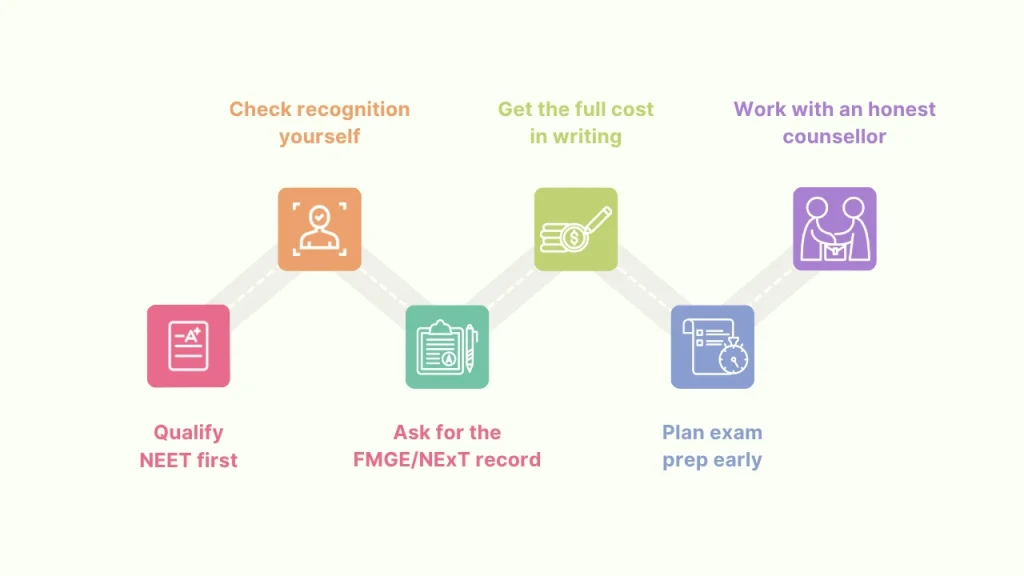
How to study MBBS abroad safely (step by step)
If you decide to go ahead, follow these steps to avoid the common traps and protect your career.
- Qualify NEET first. Keep a valid NEET qualifying score — it is required for the FMGE/NExT later.
- Check recognition yourself. Confirm the university is in the WHO World Directory and meets NMC rules. Do not rely only on an agent’s word.
- Ask for the FMGE/NExT record. Choose universities whose students actually pass the exam.
- Get the full cost in writing. Tuition, hostel, food, visa and later-year fees — so there are no surprises.
- Plan exam prep early. Treat the licensing exam as part of the course from year one.
- Work with an honest counsellor. Pick guidance that explains risks clearly, not just sales talk.
Decide with honest, expert guidance
Plus One Global Care has guided 1,500+ Indian students to NMC-approved, WHO-listed MBBS abroad universities across 10+ countries — with straight-talking advice and support that does not end at admission. verify stats
Frequently Asked Questions
Is studying MBBS abroad a good idea for Indian students?
Yes, if you choose an NMC-approved, WHO-listed university and prepare for the FMGE/NExT. MBBS abroad gives Indian students an affordable, recognised path to becoming a doctor — but it is only a good idea when the college is recognised and you are ready for the licensing exam.
Is a foreign MBBS degree valid in India?
It is valid only if the university is WHO-listed and NMC-approved and you clear the FMGE (or NExT) screening exam. Without both, you cannot register with a state medical council or practise in India.
How much does MBBS abroad cost for Indian students?
A full MBBS abroad usually costs about ₹20–45 lakh for the whole course, depending on the country and university. That is far lower than the ₹60 lakh–₹1.2 crore many Indian private colleges charge. verify current fees
How hard is the FMGE exam?
The FMGE is hard: in the June 2025 session only about 18.61% of candidates passed. That is why choosing a quality, recognised university and preparing from your first year matters so much.
Which country is best for MBBS abroad?
There is no single “best” country for everyone. Russia, Georgia, Kazakhstan and the Philippines are popular for their cost and recognised universities. The right choice depends on your budget, NEET score and the university’s FMGE/NExT track record. Compare options on our country pages, such as MBBS in Russia
Is MBBS cheaper abroad or in India?
For most students, MBBS is cheaper abroad than at an Indian private college. Abroad costs roughly ₹20–45 lakh in total, while Indian private colleges often charge ₹60 lakh–₹1.2 crore. Indian government seats are cheaper still but extremely limited.
What are the main disadvantages of studying MBBS abroad?
The main disadvantages are the tough FMGE/NExT exam, the risk of a non-recognised college, language barriers during hospital training, climate and culture adjustment, hidden living costs, and uneven teaching quality between universities.